How to recover from the "oh no! I did a git reset and now my files are gone!" – 087

If you don’t know about git reflog, your life is about to get much, much better. Prepare yourself. Git is about to make just a bit more sense.

Note: I use the git visualization tool at the bottom of this post, in case you want to jump straight to the “How on earth is this possible?! I give up. Git is just magic.”

Using yesterday’s tip, suppose you have a repo with 6 files each with their own commit.

git bash showing 6 commits

Cool. Now let’s say you did a `git reset –hard <commitID for file4>` to reset back to file 4. Note: any flavor of git reset will work for today’s scenario, since we’re not making any changes in our working directory (or so I think).

To recap these past several days:

  • git reset changes history and should be avoided if you’ve already shared those commits with others (e.g. you use it when you haven’t pushed yet.)
  • git revert undoes a commit by creating a new commit with those changes uncommitted (wow, what a sentence. My apologies.)

image

Notice how the above image confirms the git log only shows the commits up to file 4.

In addition,`ls` and `git ls-files` shows how files 5 and 6 are “gone”!

ls and git ls-files not showing files 5 and 6

will the real Git Log please stand up? please stand up. please stand up.

The command`git reflog` will show you the actual history of your git commands AND THEIR COMMIT IDS!!

output of git reflog

what?! what?! what?!

The lightbulb moment for me was that git was keeping those commits around, and not to mention git is also keeping an actual log of everything going on alongside my repo’s git log.

Let’s get those files back.

You’re going to do another git reset, but this time, you’re going to change history by rolling forward instead of rolling backwards.

so you’ll do `git reset –hard <commit id for file 6>`

git reset --hard commitID showing files 5 and 6 come back

and all our files are back. In fact, if we do a `git log` we’re back to where we were at.

git log showing all commits back

How on earth is this possible?! I give up. Git is just magic.

Let’s learn some magic tricks using the git visualization tool at http://git-school.github.io/visualizing-git/

alrighty. let’s rinse and repeat the setup

git visualization showing head and master at file 3

notice how the commits for files 4, 5, and 6 are there, but just dotted out (or whatever the official term is).

So we never “deleted” those commits. We just told git to hide them from ourselves, but not from git.

Now for the magic. We can do a reflog here in this tool.

using git reflog and git reset back to file 6 in tool

Notice how HEAD and master pointers just move back to that commit ID. That’s it. These HEAD and masters pointers are just that… pointers.

This is why people say “don’t delete your .git folder and start over.” Your changes aren’t “gone”. They are just playing hide and sneak because you told them to.

Got to  get back. Back to the past. Samurai Jack!!

How to write a Bash or PowerShell script to quickly create test repos – 086

TFW you learn something that saves you a ton of time.

Our GitHub services team has on-demand content for learning Git, including a Git out of Trouble section. On page 2 git-set-up they show you how to create a script to create several files, commit them to your repo, one file at a time.

I’m using Git Bash, so here’s the Bash script

for d in {1..6};
 do touch file$d.md;
 git add file$d.md;
 git commit -m "adding file $d";
 done

First, you’ll want to do `git init` otherwise, you’ll get yelled at by your shell for not being in a git repository.

Just copy and paste that into your shell (terminal or whatever),

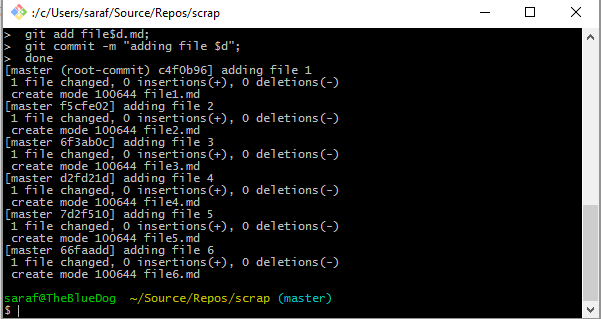
script pasted into a Git Bash command prompt

Press Enter,

 git messages shown as script is run

and enjoy your Git out of Trouble explorations!

git status showing a commit for each file

How to revert changes in Visual Studio – 085

Yesterday’s tip talked about how to use `git revert` from the command line. Today’s tip describes the functional equivalent in Visual Studio.

TBH I clicked the wrong command in VS initially when I started writing this post. I clicked “reset ” then the “–hard” option, which should have been a hint. Revert doesn’t have the soft, mixed, or hard options. But, I was able to fix my git history (by going to the command line) to write this tip without deleting my .git folder and starting over, which is a first for me. So perhaps all this work writing out these tips is working!

Let’s say you have a console application that shows a blue background. And you’re like “no.”

console app with blue background

You want to remove this commit altogether. If you’ve been committing in small, atomic chunks of code, you should be able to revert this background color change. But don’t take my word for it. I wouldn’t know because I’m still trying to train myself to do small commits.

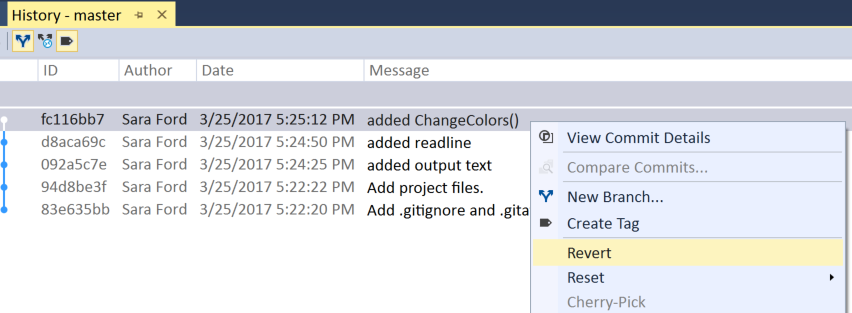
Going to the history shows where this change was introduced, i.e. “added ChangeColors()”. You can revert this commit by right-click and selecting “Revert.”

History - Revert on selected commit

Click Yes on the confirmation prompt.

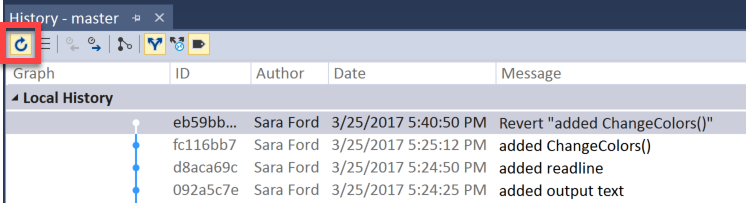
If you refresh History, you’ll see the new commit.

Revert "added ChangeColors()"

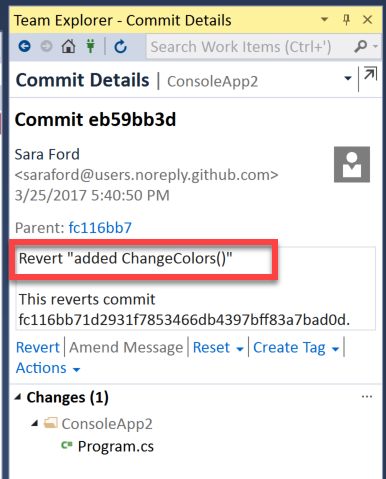
You can double-click to open that commit’s details. If you edit the commit message, the Amend Message option will become available.

reverted commits details

Double-clicking on the Program.cs file listed under Changes for the Commit Details pane shows what’s been removed or “reverted” from the codebase.

Changes for Program.cs showing the ChangeColors method removed

And to verify we are back to our familiar console application background, let’s run the project.

default black background for console app

How to use git revert to undo a previous commit – 084

“undo”, “reset”, “revert” – ah English! Perhaps the author of The Giver used Git in the past, since one of their rules was “use precision of language.”

What do we mean by “undo a previous commit?” Let’s say we had 3 commits A, B, and C. And we realize ‘B’ was a mistake. Perhaps we changed a color to red, and it should go back to white. But we don’t want to pretend that ‘B’ never happened. That would mean modifying Git history, and Git really hates changing history if you have the repo shared with others.

So yeah, you could rewrite the code to manually undo the changes introduced in ‘B’, or you could let Git do that for you by running `git revert <commitID>`

git revert <commitID>

As you see in the above graph, using this git visualization tool, a new commit is made with the changes introduced from ‘A’ removed. The take home message is that a new commit is made, instead of “commit A” vanishing.

I like this Stack Overflow answer:

If I found B I committed before is wrong, and I want to “undo” its change, git-revert-ing B will cause:

A <- B <- C <- B'
               ^ HEAD

for which B' is reversing the change done in B

Now to the command line to see this in action!

Say you’ve added three files: A.txt, B.txt, and C.txt for commits A, B, and C, respectively. (One day, I’m going to blog about a list of files being out of order, “dis-respectively “)

We want to “undo” the changes introduced in B.

git log showing commits A, B, C

—STOP!!—

If you are following along at home, let’s pause for a second and make sure your core.editor is configured to use your preferred text editor.

The read between the lines: you’ll want to know how to exit whatever editor comes up.

git config --global core.editor showing notepad

Right now I’m using notepad to give me a fighting chance instead of the vi editor, aka the destoryer of CS careers. YMMV, so check out this GitHub help article on setting up an preferred text editor. Hint: it’s `git config –global core.editor notepad` if you want to use notepad across all your repos.

Okay with that taken care of, let’s do the revert. We want to “undo” the B.txt commit, so let’s party w `git revert <commit id for B>` and suddenly a wild notepad appears!

image

Since I’m cool with the default commit message “Revert ‘B’ for this demo (remember, git revert creates a new commit so it has to get a commit message from you), simply close notepad (File – Exit or ‘x’).

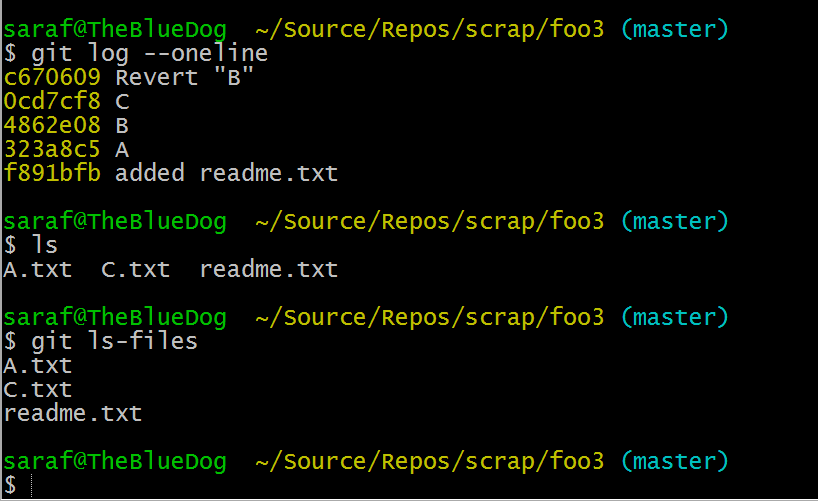
Now if you do your git log –oneline, you’ll notice the new commit. If you do a `ls` or `dir` and the git-equivalent to see what files git is tracking `git ls-files`, you’ll see that B.txt is no where to be found.

git log, ls, and git ls-files not showing B.txt

Once again to recap what we did. We could have simply deleted the file B.txt and committed those changes. But for a more complex scenario where you need to remove a feature that consists of more than a single file or line change, you should consider using `git revert`.