Month: March 2017

How to use the arrows in the View History graphs in Visual Studio – 078

There was a saying back in Mountaineering Search and Rescue* in Seattle about why you should *never* pack cotton-based clothes in your cold-weather gear. It went like, “No matter how far down you pack cotton in your bag, water will find it.”  I feel the same about Visual Studio. “If there is a clickable pixel somewhere in Visual Studio, no matter how small or obscure you place it, I will find it.”

As I was prep’ing yesterday’s tip, I noticed that the View History graph showed these arrows pointing in various directions. TBH I had to ask someone to explain what the arrows meant.
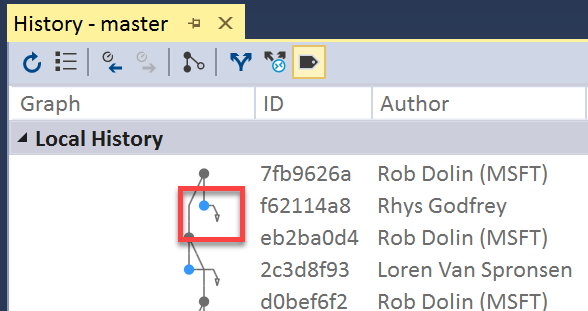
Graph with arrows pointing down

If you click on this downward-facing arrow, a connector line will appear!

graph connecting line shown going offscreen

The connector line will go all the way down off screen until it reaches its commit.
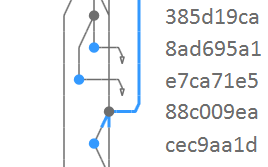
connecting line reaching its commit

The idea behind these arrows is to show you that they connect to a commit that’s not currently visible on the screen.

BTW, the arrows can also point upwards as well, reaching back up to its counterpart in the graph.
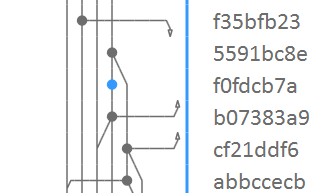
arrows pointing in either direction

*So yeah, about search and rescue, well over 10 years ago, genius here wanted to volunteer to learn more about hiking and volunteer my time and whatever skills to helping out, since I love the outdoors so much. Only one small problem… I hate the cold! And I had never camped in the cold before, and at that time anything below 70 was considered cold to my NOLA standards. Anyways, it was 27 degrees one particular weekend of training. I made it the first night, but was never able to get to sleep. The second night I dropped out so my partner (who was kicking butt and taking names) could find other same skill-level people so she could pass. But yeah I still laugh at the thought of me thinking I could go find people lost in the woods when I get lost driving down the street!

How to use `git log –first-parent` to only view commits that happened on a given branch – 077

First Parent Only via Visual Studio – View History

By default the View History option in Visual Studio (from Changes – Action – View History or from the Status bar  – <branch name> – View History) shows all commits, regardless whether the commit occurred in a separate branch or on the current branch. Let’s assume master is the current branch for simplicity. I’m using Open Live Writer as an example.

Shout out to http://marcgg.com/blog/2015/08/04/git-first-parent-log/ who has a great write-up on when you’d use –first-parent.

Right now on Twitter, developers are sharing how much they have to look up things. “Hi, my name is Sara. When I look at the Git history graph, I see a praying mantis.”

local history for master branch showing crazy graph

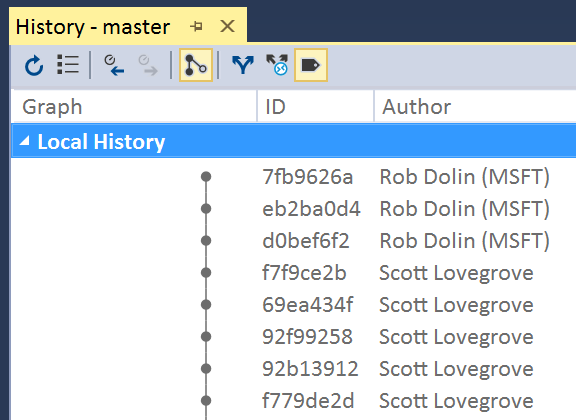
If you only want to see the changes that occurred on master (or whatever branch you are currently viewing the history for), you can click the Show First Parent Only button.

Show First Parent Only

Now you’ll only see commits that occurred directly on the branch itself (and not on another branch that got merged into the current branch).

Local History now a flat graph

Command Line git log –first-parent

Rinse and repeat for command line.

From yesterday’s tip, if you run git log –graph –pretty=oneline –graph –abbrev-commit

git log --graph --pretty=oneline --graph --abbrev-commit

You’ll see all of the commits from different branches.

Now add the –first-parent option at the end: git log –graph –pretty=oneline –graph –abbrev-commit –first-parent

git log --graph --pretty=oneline --graph --abbrev-commit --first-parent

Thanks again to http://marcgg.com/blog/2015/08/04/git-first-parent-log/ for the great description! As I said above, I just see a praying mantis. 🙂

How to view a git log graph from the command line that looks like Visual Studio View History – 076

It feels like there are 100 different ways to do a git log. Here’s one possible way… I’m using the OpenLiveWriter repo to demo since it has lots of branching going on.

P.S. The way to exit these log commands is to press ‘q’ when the colon appears, if you are following along at home.

let’s start with git log –graph.

git log --graph command line

But it’s too wordy to show the graph.

Let’s try git log –graph –pretty=oneline

git log --graph --pretty=oneline

Better, but the long commit IDs are throwing everything off.

Let’s try git log –graph –pretty=oneline –graph –abbrev-commit

git log --graph --pretty=oneline --graph --abbrev-commit

And that’s about as close as I can get to a graph that looks like the graph in Visual Studio.

If you know of a better way, please share with the group! 🙂

How to open files in a repo that doesn’t contain a solution in Visual Studio 2015 – 075

tl;dr if you have a repo that doesn’t have a solution, don’t worry. You can still use File – Open – File to open files associated with the repo and Team Explorer will still track those files the same as if a solution were open.

P.S. I’m writing these tips for VS 2015. I’ll need to update for Visual Studio 2017.

For all my adult life (minus 2 years), the Solution file was your go-to starting point in Visual Studio. Even if you create a new text file via File – New – File, Visual Studio creates a new Solution nevertheless.

a solution still appears

It’s almost like Visual Studio has a Solution that’s in search of a problem.

Can’t believe I’ve never thought of that one before… Anyways…

Repos that do not contain a Solution

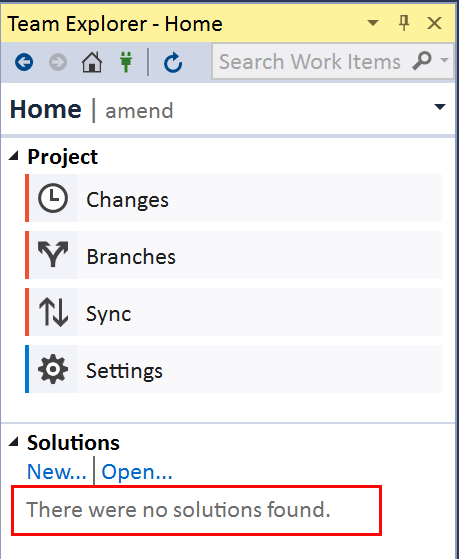
If you open a repo that doesn’t have a solution in it, you’ll see the following:

no solution found

You can still go to File – Open – File and open files that are associated with that repo. In fact, File – Open – File will open to that repo’s folder.

Opening a different Solution when Team Explorer is connected

A solution will always take precedence over a repo opened in Team Explorer.

For example, in the previous screenshot, I have a repo named “amend” that’s open, but this repo doesn’t a Solution. If I open a different solution that does not contain a repo, you’ll see that Team Explorer goes offline.

Team Explorer Offline

I guess this is Team Explorer’s way of saying, “Hey Look, I don’t want you to get confused which solution is tied to which repo.”

Switching to a different Repo with a Solution Open

Now having said that, let’s suppose I’m connected to a repo that has a solution, let’s say some ConsoleApplication54 project (you know you have them!) and you have the ConsoleApplication54 solution opened.

If you switch repos (via Team Explorer – Manage Connections) to any other repo, regardless whether it has a solution file opened, you’ll be in an odd state. On one hand you’ll have a solution opened, but Team Explorer will be tracking changes for an entirely different repo. This is the state you couldn’t get in to in the previous section.

It’s almost like a Game of Thrones battle (or so I’m told – haven’t seen or read yet) being played out inside the IDE: solutions vs repos.