How to diff a file between two branches using VS as your difftool – 107

Suppose you want to diff a specific file between two branches. The best* git command I’ve found is in this SO answer (only because I’ve found a couple of other sites reference it)

$ git diff branch-name path/to/file

The SO answer says to use `..` in front of branch-name, but I’ve found it works without it. There are WAY too many variants of these commands to keep track of.

I’d love to figure out where this command option is in the official docs but it is pretty overwhelming list.

In a previous tip, you saw how to use VS as your external diff tool. As the blog post title describes, here’s how to do it

$ git difftool branch-name path/to/file

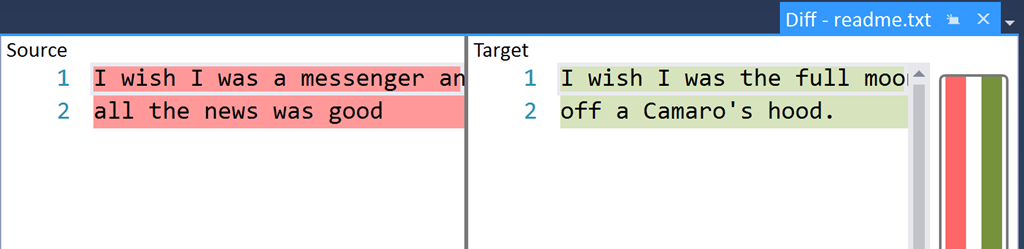
for example, the name of my branch in the image below is `readme` and my filename is `readme.txt`.

I don’t have to provide a path to the readme file since it is at the same location as my current directory.

image

and volia Visual Studio appears**

diff of two different pearl jam song lyrics across branches

* I have no idea if this is the best answer. I’ve read that there’s old syntax and new syntax. I’d love to hear people’s suggestions in the comments!

**I’ve noticed in VS 2017 that VS must be running. Otherwise, the IDE is launched, but the tool doesn’t appear. If you re-run the command via command line, the dif will appear. YMMV

And yeah, I wonder what genre of music I listen to when I write 🙂

How to use Visual Studio as your external merge tool – 106

Hmm, I wonder what could possibly be my tip for the day after yesterday’s tip!

In yesterday’s scenario, you saw how to use VS to do a diff. In today’s tip, you’ll see how to do a merge when you do `git merge branch-name` and get into a merge conflict. Hopefully you’re feeling a bit more confident when you see merge conflict now. (Yeah that’s actually my hope for myself.)

First, go to Team Explorer – Settings – Git – Global Settings and for Merge tool, click Use Visual Studio

Merge Tool: Use Visual Studio

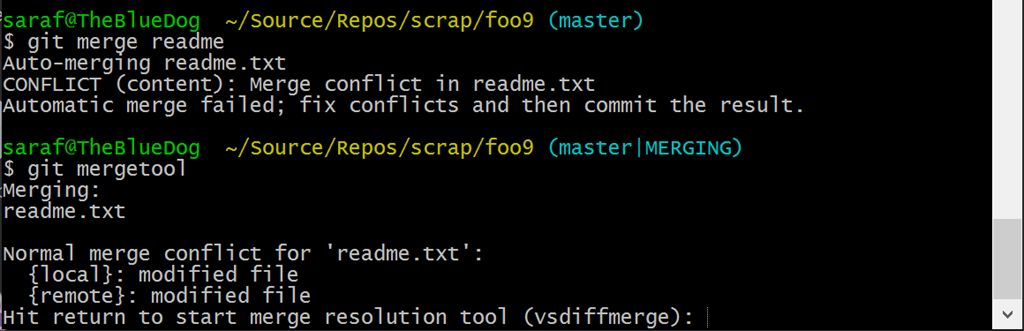
Suppose you have a file in one branch (mine is called readme) that contains a conflict. When you go to merge into master, you’ll see a merge conflict.

You can open the mergetool by running

$ git mergetool

git mergetool prompting to open in VS

Follow the instructions and hit Enter.

Now the VS Merge tool appears

VS merge tool

Clean up your readme.txt in the bottom part of the screen (or however you want to use the merge tool).

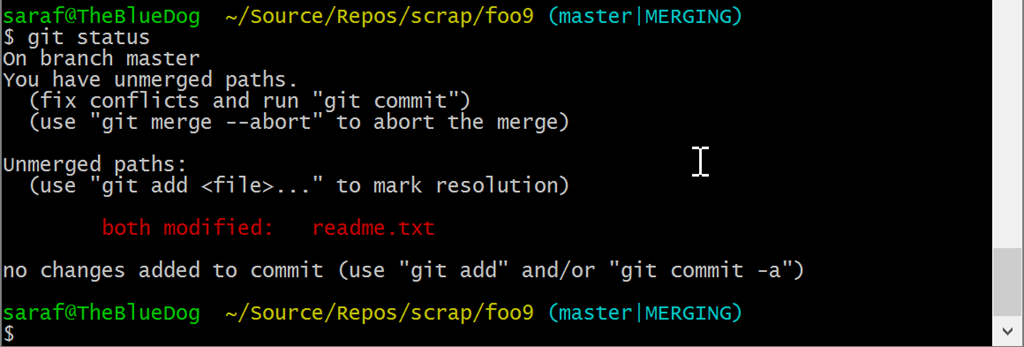
Now we’ll see that we have changes in our working directory.

need to do git add to stage changes from merge

You can do a `git add readme.txt` to add this file to staging.

file added to staging

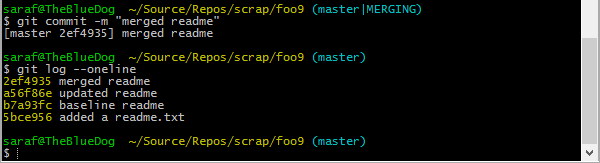
And now we commit our merge commit via `git commit -m “merged readme”`

committing our merge commit

and the `git log` confirms our merge.

How to use Visual Studio as your external Git difftool – 105

Thanks again to Ed Thomson’s Git for Visual Studio O’Reilly course! I searched for a solid hour how to manually configure VS as your external diff and merge tool. I knew I had seen it somewhere. Then I remembered Ed’s course!

Go to Team Explorer – Settings – Git – Global Settings. Then for either difftool or mergetool or both click Use Visual Studio

Diff Tool: Use Visual Studio

Suppose you have at least one commit and you’ve started making changes to that file in your working directory.

Now you can do

git difftool

which will bring up a prompt asking you to confirm launching your external diff tool vsdiffmerge (the tool VS uses).

Press ‘Y’

git difftool prompt

And now VS will launch and open with the diff tool showing the original Source (i.e. the file in the last commit) vs the changed file Target (the one you changed in the working directory)

I wish I was a messenger and all the news was good - diff in VS

BTW the reason why the tab is shown on the right side of the file tab channel in VS instead of the left is because this is a temporary file that isn’t listed Solution Explorer. Back in the day, you’d have to add this to the miscellaneous project, but not sure how that all works today. But I digress….  🙂

So let’s see what the Use Visual Studio link did by using these two commands

$ git config diff.tool

$ git config difftool.vsdiffmerge.cmd

git config diff.tool and git config difftool.vsdiffmerge.cmd

And the `difftool.vsdiffmerge.cmd` line is the magic line I was hunting the Internet for. Thanks Ed’s course!

How to configure an external diff and merge tool in Git – 104

One of my favorite Nintendo NES games was Dragon Warrior. It made you finish the game. At level 30, you couldn’t gain any more experience points. The mentor wizard person (because there’s always a mentor wizard person) would tell you, “Aren’t you strong enough to defeat the DragonLord?”

As I debated whether I knew enough to write a tip about configuring your git diff and merge tools, I ask myself “Aren’t you strong enough to defeat the git diff merge config tool?!”

More about the game at bottom of post…

For today’s tip, I’m using the git-scm instructions and this translation for Windows

Let’s start by engaging in epic battle with the git-scm instructions. I’m going to assume you’ve installed p4merge. Yes I know there are others, but for now, I’m going to follow these instructions. The journey to 3rd degree black belt starts with a single punch.

These are the two lines I get stuck on:

$ git config --global merge.tool extMerge
$ git config --global mergetool.extMerge.cmd \
  'extMerge "$BASE" "$LOCAL" "$REMOTE" "$MERGED"'

so why need two lines? Perhaps I’m not recalling enough of my shell programming or the translation fails over to Windows? The instructions say

Set up a merge wrapper script named extMerge that calls your binary with all the arguments provided

so `extMerge` is a variable. But why can’t you have it all on the same line?? What am I missing?

and also, what is “mergetool”? is it yet another variable? and how does it differ from merge.tool?

Anyways…

I’ll assume you have p4merge installed here in C:\Program Files\Perforce

Thanks to these for Windows we can setup p4merge as our merge and diff tools using Git Shell (I’m using Git Bash)

$ git config –global diff.tool p4merge
$ git config –global difftool.p4merge.path ‘C:\Program Files\Perforce\p4merge.exe’

$ git config –global merge.tool p4merge
$ git config –global mergetool.p4merge.path ‘C:\Program Files\Perforce\p4merge.exe’

Now let’s create a merge conflict, but this time, I’m going to keep my heart rate low when the (master|MERGING) appears! Btw I called my branch `conflicting` just because.

merge conflict state

now you can type in git mergetool

git mergetool showing p4merge

I’m not going to go over p4merge, but I think the “error” showing for the base file is because p4merge is trying to do a 3-way merge, but only has 2 files. Don’t quote me on this.

After modifying the resulting myfile1.text and hitting save in p4merge and closing it, we’re back to the merge conflict state. This used to freak me out because git didn’t “move on”. But now I know what to do!

You can do a `git status` to verify where you are at.

git status showing myfile1.txt as staged to be committed

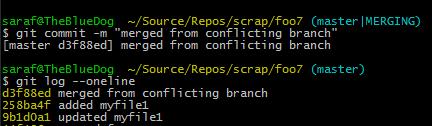
Perfect! We’re done with myfile1.txt and it is staged. Since it is staged, we can simply commit it via `git commit -m “my merge message”`

committing the merge shows in the log

And boom! I’ve now done epic battle with one of my most feared Git foes.

The most memorable aspect of the game was the ending… but not for the reasons you’d think. The game had their basic “hero” ending, but it also offered a twist. Before going into battle with the Dragonlord, he’d ask you to join him in being evil and taking over the universe. If you said yes, the game would “freeze” and IIRC, it would erase your saved game! I’ve never heard of another game doing this. There’s the “did you give a dog a sandwich?” story, but not a “come join the dark side” option destroying your saved game!