Month: April 2017

How to practice getting into and out of a detached HEAD state via command line – 096

Yesterday’s tip went over the visualization of what happens when you are in a detached head state. Today’s tip now applies it to the command line.

Suppose you’ve initialized a git repository using the bash script from a previous tip. I’ve only used 3 files to be concise.

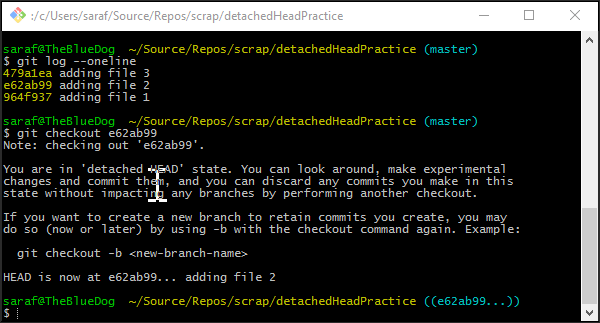
And you’ve did a git checkout <previous-commit-ID> to get into a state similar to Stephen King’s IT trailer. (don’t worry no videos here*)

detached head state

Remember your training.

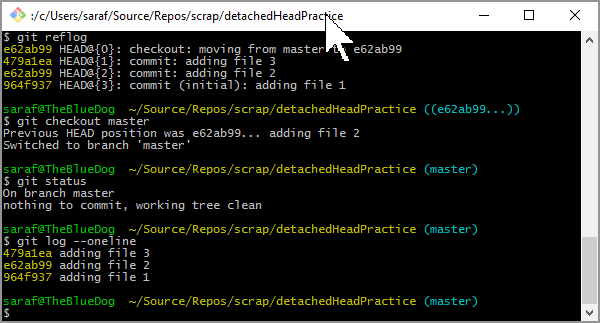
Optional: let’s do a git reflog to get that sense of security that all of our commits are still there. Even though the file 3 commit is “gone”, the reflog verifies all is well.

git reflog showing all history

Now let’s get out of that detached head state by doing a git checkout master. Previously, I would have done git checkout <last-commit-ID> and freaked out that I was still in a detached head state.

head back to pointing at master

And now all is good in the world again. We see master in blue. We see all 3 previous commits. And our git status isn’t like something from a Stephen King movie.

*As many of you know, I used to be a professional clown. Clowns don’t scare me, but wow seriously that trailer is scary! 

How to practice getting into and out of a detached HEAD state – 095

I promised that this blog would be a pun-free zone, but I must recommend Terry Pratchett’s The Thief of Time. It’s the last book of the “Death”  series. In fact, I recommend starting with Soul Music. Anyways I kept thinking of that creature as I wrote this tip.

So far, my two biggest lightbulb moments have come from learning about `git reflog` and this git visualization tool. Nothing came close to making sense until I combined those two.

Let’s use the visualization tool to practice getting in and out of a detached HEAD state.

First, let’s make a few commits…

initial setup in visualization tool

Next let’s checkout to the previous commit. Note: it helps to type in the commit id correctly, so ignore the “can’t find commit id”

visualization tool showing a detached HEAD state

Notice in the image above indicates that we’re in a detached HEAD state. Previously, I would have panicked because my last commit (the one master is pointing to) wouldn’t show up in the git log. But now because of this visualization tool, I can see that master is still there and that HEAD is just pointing at the previous commit.

To get out of the detached head state, you’ll need to git checkout master.  Previously, I would do git checkout commitID-master-is-pointing-to and still be in a detached state, frustrating me to no end.

back to a non-detatched head state

Now you’ll see that HEAD is pointing to master and we’re no longer in a detached HEAD state.

Tomorrow we’ll go over getting into and out of a detached HEAD state via the command line.

How to not quit your career when Git (via Visual Studio) adds <<<< HEAD into your code – 094

I studied Shotokan Karate for 20 years. At the start of each class, you’d say the Dojo Kun. At the beginning, I viewed the sayings as the rules of engagement, similar to FIFA laws. But over the years and decades, it starts to bleed into your subconscious as a way of viewing other situations in life. The most important of these rules is the last, “Refrain from violent behavior.”  The idea is you’re supposed to avoid any fights, etc. at all costs. Because of this philosophy, I have argued that karate is really the study of non-violence. I could go on and on about the importance of the only winning fight is the one that isn’t started, there’s no such thing as a first punch in karate, and so forth.

The first time I saw <<< HEAD and >>>> branch-name edited into my code*, my coffee mug went flying across the room.

Today’s tip is a walkthrough of resolving a merge conflict from within Visual Studio. We’ll cover command line in upcoming tips. Must… pace… self…

Suppose you have some existing output text in our ConsoleApplication in master. And you’re going to merge in text from a branch called decorations that also includes output text. Because both branches have changes in the same section, you’ll get a merge conflict. Let’s see how Visual Studio 2017 handles it.

First, do everything as shown in previous tips…
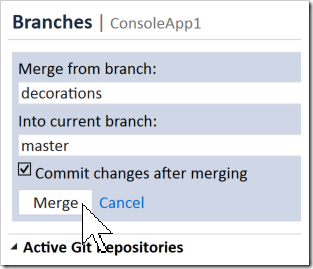
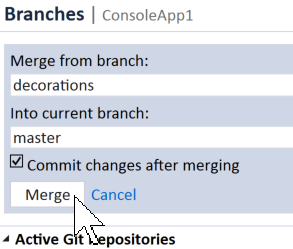
merging from decorations into master

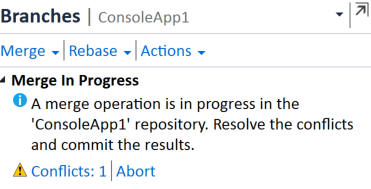
But this time when you hit Merge, you’ll see the following

Merge in Progress - Conflicts: 1 message

Take a deep breath.

Now take another deep breath.

Resist the temptation to “fix” your code by removing the <<< HEAD and >>> decorations modifications. Let your build errors light up like rush hour traffic in your VS code margin gutter thingy.

Now click Conflicts: 1

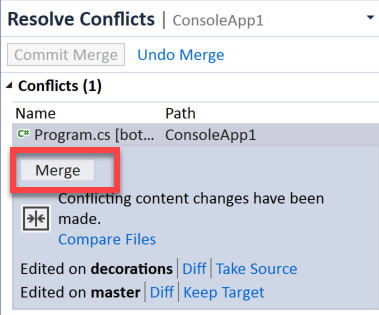
You’ll be given an option to either Merge or simply take either the code from decorations or master w/o “merging”
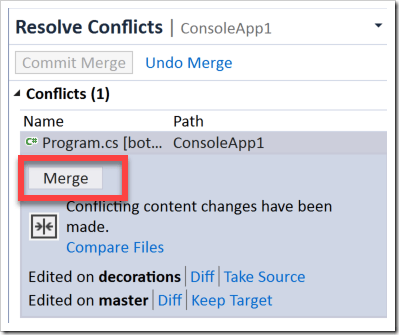
Merge button for a conflicting file

Clicking the Merge button will take make use of that <<<< HEAD and >>> decorations gobbledygook by presenting you with a merge tool (in this case presented within VS).

Suppose you want both changes. You can click the checkboxes on both sides and you’ll see the result in the bottom screen.
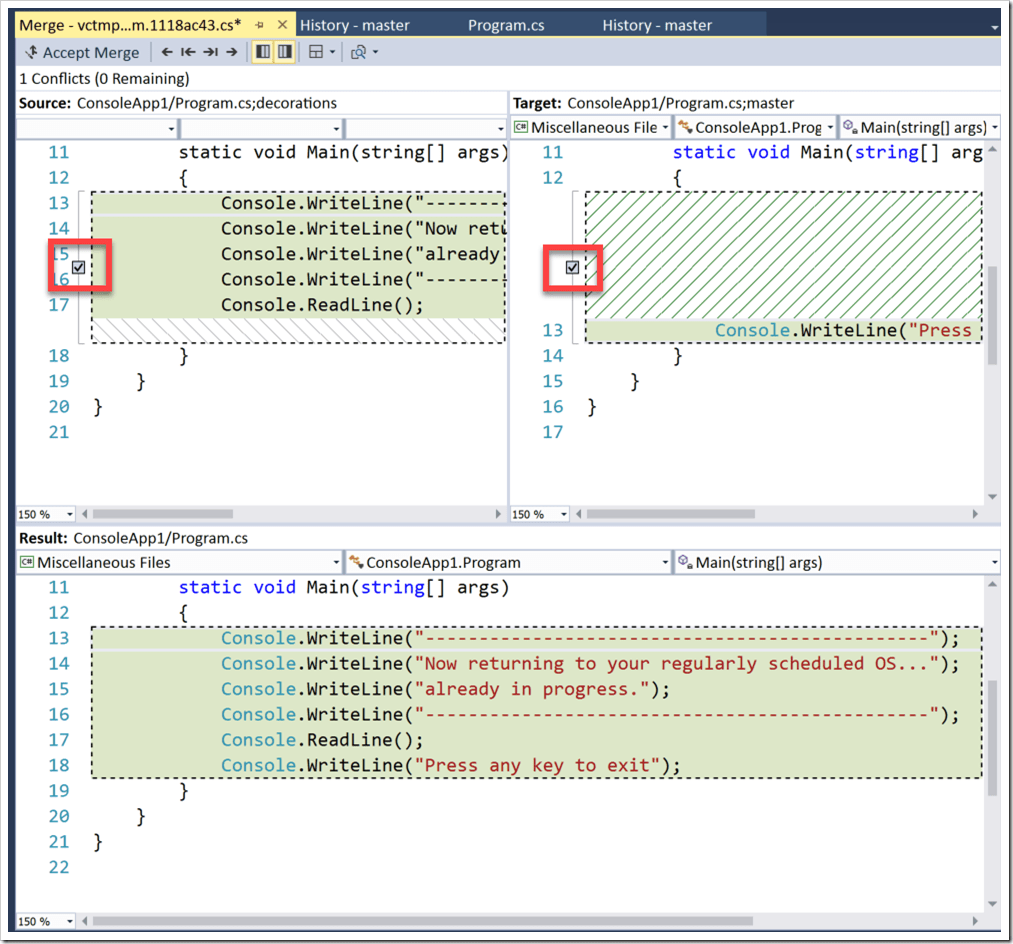
VS merge tool

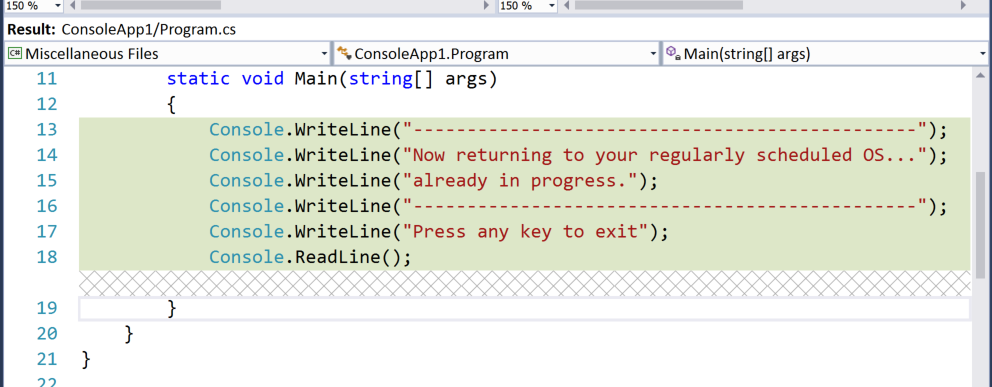
Notice how the resulting merge shows the Console.WriteLine() at the wrong location, which makes sense. The two code blocks were merged in a way that makes sense.

The bottom window is editable. A quick cut and paste puts the WriteLine() before the ReadLine() so it can be seen before the keypress to exit.
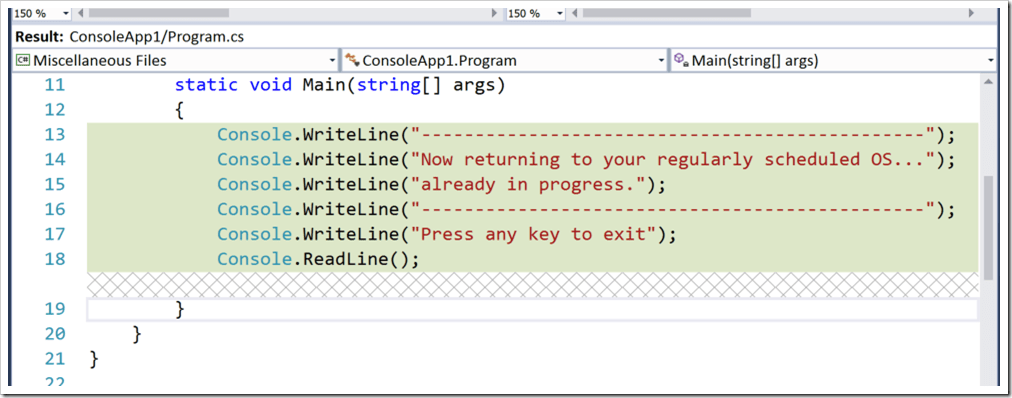
editing the resulting window screen

Hit Save and then hit Accept Merge at the top of the merge tool
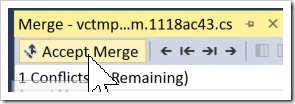
Accept Merge button at the top of merge tool

And yet another button!! O_O

Now back in Team Explorer, click Commit Merge.
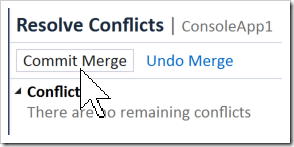
Commit Merge

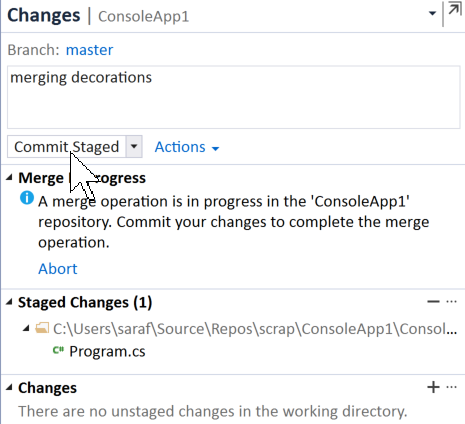
Finally, we’re going to finish the merge by typing in a custom commit message and clicking Commit Staged
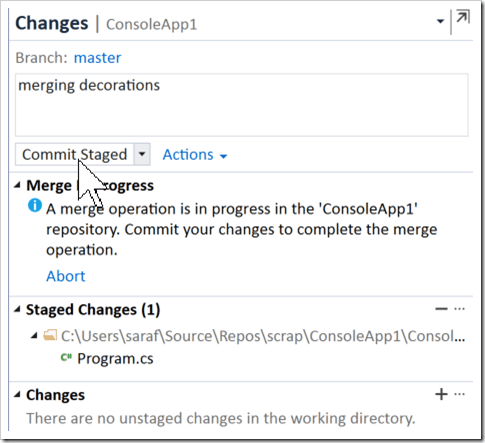
committing the merge with a custom message

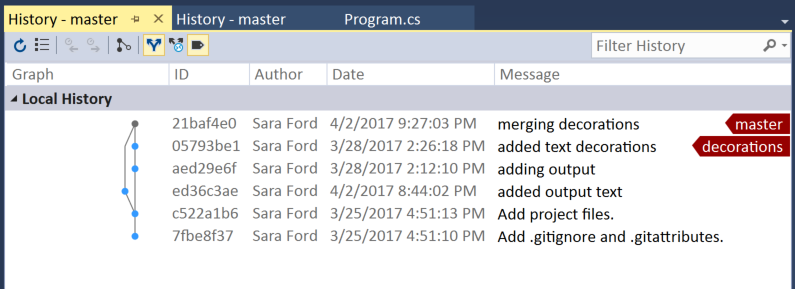
And now when you view history, you’ll see the merge into master.

History - master w merge from decorations

*What I’ve realized from learning RoR and Node.js last year is that when you’re not using a full end-to-end IDE (e.g. text editors like atom, vi, sublime, etc.) you need another way to communicate changes and other sort of “metadata.” Hence the content of the code is modified, e.g. adding the <<<< HEAD directly into the file or adding a readme.md file to your repo (which doesn’t participate in the build). Once you start to know the backstory why things are the way they are, the world becomes a lot safer for coffee mugs.
How to do a non-fast forward merge in Visual Studio – 093

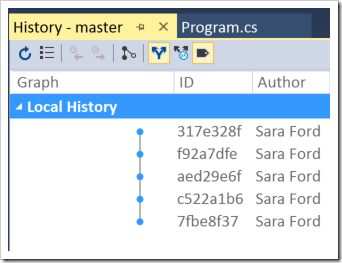
Yesterday’s tip was about how to do a fast forward merge, which shows all the commits still in a linear graph.

linear graph from a fast forward

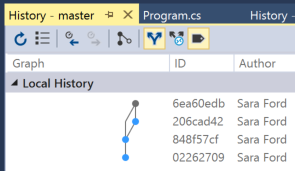
Today’s tip is how to do a non-fast forward merge, meaning the graph history will show the branch being merged in

graph showing the branch merge for non-fast forward

Note: I had to use Visual Studio 2015 for this demo. There seems to be a bug in Visual Studio 2017 where the checkbox isn’t respecting local repo settings.

Let’s suppose you have a branch called test that you want to merge into master, but you want to retain the merge history in the graph.

Follow all the steps from yesterday’s tip, but today, you’ll uncheck the Commit changes after merging

image

Now you’ll get a message in Visual Studio. note: VS 2017 ignored the unchecked box and did the commit anyways.

merge in progress message

Train yourself to take a deep breath whenever you see a message from Git.

Switch to the Changes page, write a commit message, and hit commit staged.

committing a merge in progress in Changes window

And now your git history shows the merge from the branch.

merge from the branch now in the graph history

Visualizing what we did

We have a commit on the test branch we wish to merge, but retain the history.

git visualization tool showing a test branch

Now we’ll do a merge, but notice we’re using the –no-ff option, which means “no fast-forward” this time.

test being merged into master using no fast foward

Note: looks like the visualization tool requires at least 2 commits to demo the –no-ff option. Otherwise, you’ll get an error.

Does someone want to open a bug in the tool’s repository and call First! in the comments below?  I’m too tired from trying to stay awake to watch Samurai Jack. Why Comedy Central? Why did you think it was an okay April Fool’s Day joke to put some random cartoon on at the 8pm slot??  It’s only 9:47pm and I can’t stay awake to log bugs, much less make it to 11pm for Samurai Jack repeat. Or what if they don’t show Samurai Jack and repeat the cartoon?! See what your April Fool’s joke has done?!  I‘m off to bed.