Tag: visual studio

How to commit and visualize code on different branches in Visual Studio – 089

Yesterday’s tip visualized what happens in Visual Studio (and in Git) when you create a branch. Today’s tip visualizes committing code independently in different branches.

First, you’ll see how to commit to separate branches in Visual Studio, then we’ll rinse and repeat in the Git Visualization tool.

Committing to Different Branches in Visual Studio

In this example, I’ve rolled back to the Console Application with only output message. We’re going to add the ChangeColor() method and call on a branch called addColor.
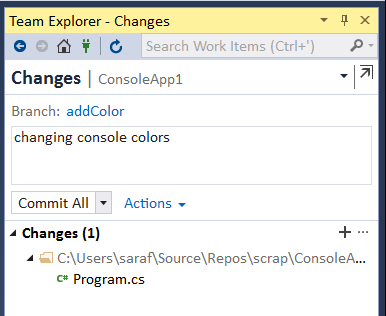
ChangeColor() committed to addColor branch in Team Explorer

Once you’ve pressed Commit All to addColor, you’re going to discover that you want to experiment with decorations. You can use Team Explorer – branches to create a new branch called decorations.

You’ll want to use master because you want to keep the addColor changes separate from your decorations branches.

Creating a new local branch from master in Team Explorer

and you’ll want to verify you were on master in the dropdown

creating branch from master called decorations

Add your decorations to your project file
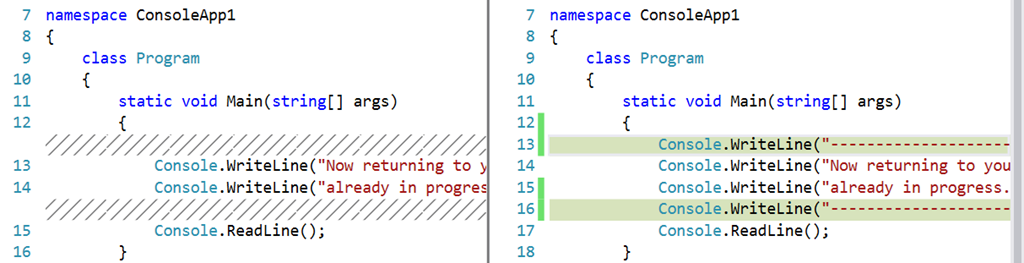
adding more output decoration text

And now commit those changes to your decorations branch.

committing to decoration branch

And now we have 2 different commits on 2 different branches

3 branches in Team Explorer

Visualization of what we just did

First, we’ll want to create and checkout a branch called addColor and make some changes there.

git commit, checkout -b addColor, commit visualization

Next, we’ll want to switch back to master and create a new branch from there.

git checkout master, git checkout -b decorations visualization

Finally, we’ll make a commit on the decorations branch.

git commit on decorations branch visualization

I keep trying to remind myself that whenever I do a checkout, reset, etc. I’m not really going forward and backward in time, but rather I’m moving to a different nodes on a graph. Visualizing what git is doing helps break my timeline mental model.

How to create a branch in Visual Studio – 088

It seems that I have to write these tips in triplicate: 1. command line, 2. Visual Studio, 3. git visualization tool. But that’s been the only way to prove to myself I’m grasping the concepts.

Command line

A college French professor once gave me the advice to never use contractions in class unless I was prepared to never ask him to slow down. I had just learned the equivalent of “I do not know” vs “I don’t know” (something like that).

Applying that advice to software, I don’t want to start using git shortcuts by combining commands until it is clear what the two commands are independently doing. (Yep, I’ll show the shortcut in a second… )

First, you’ll want to create a branch:

> git branch my-branch

Next, you’ll want to switch to that branch:

> git checkout my-branch

git branch addColor; git checkout addColor

Git Visualization

Okay that’s pretty straight forward, but what’s happening conceptually?

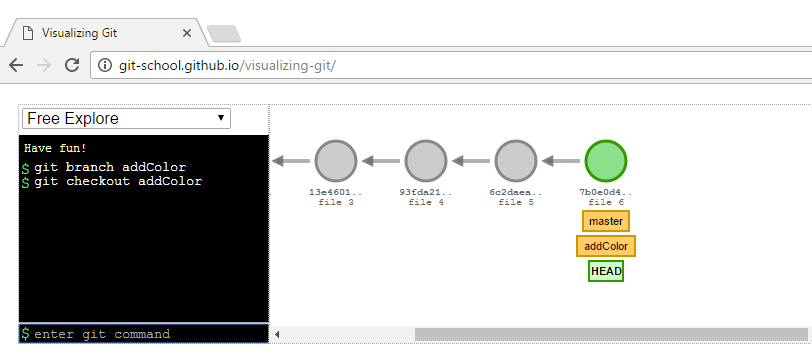
git visualization of creating and switching a branch

We are on master when we created a branch called addColor while on master and then switched to addColor.

The take home message is that addColor has everything that master has because we created the branch addColor while on Master.

Git Command Line Shortcut

Before we jump into the IDE, let’s take a sneak peek at that shortcut.

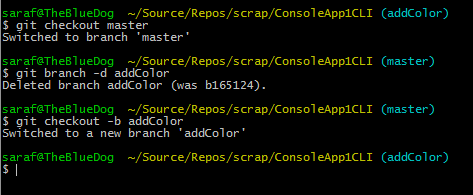
Note: in case anyone is following along at home, I first switch back to master to delete the addColor and then recreate using the shortcut.

The shortcut is

> git checkout -b addColor

deleting branch and then recreating using the shortcut

This shortcut says to checkout to addColor and if it doesn’t exist, create it.

Visual Studio

When you’re in Team Explorer, you can go to Branches, right click on the branch you want your new branch to be based on, right-click, and select New Local Branch From…

New Local Branch From... command in Team Explorer - Branches

Then give your new branch a name (and verify in the drop down you picked the correct branch) and leave the checkbox checked…

checkout branch option in Team Explorer

If you have the Checkout branch checkbox, you’re telling VS to create the branch and do the checkout so you’re now on the addColor branch instead of master.

If you uncheck it, it is the equivalent of creating the branch on the command line, but staying on master.

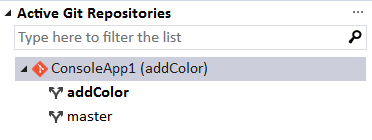
To confirm you’ve created and switched to the addColor branch, you’ll see that addColor is now in bold.

branches showing addColor now checked out

And the branch is also shown in the Visual Studio status bar.

addColor from status bar

How to revert changes in Visual Studio – 085

Yesterday’s tip talked about how to use `git revert` from the command line. Today’s tip describes the functional equivalent in Visual Studio.

TBH I clicked the wrong command in VS initially when I started writing this post. I clicked “reset ” then the “–hard” option, which should have been a hint. Revert doesn’t have the soft, mixed, or hard options. But, I was able to fix my git history (by going to the command line) to write this tip without deleting my .git folder and starting over, which is a first for me. So perhaps all this work writing out these tips is working!

Let’s say you have a console application that shows a blue background. And you’re like “no.”

console app with blue background

You want to remove this commit altogether. If you’ve been committing in small, atomic chunks of code, you should be able to revert this background color change. But don’t take my word for it. I wouldn’t know because I’m still trying to train myself to do small commits.

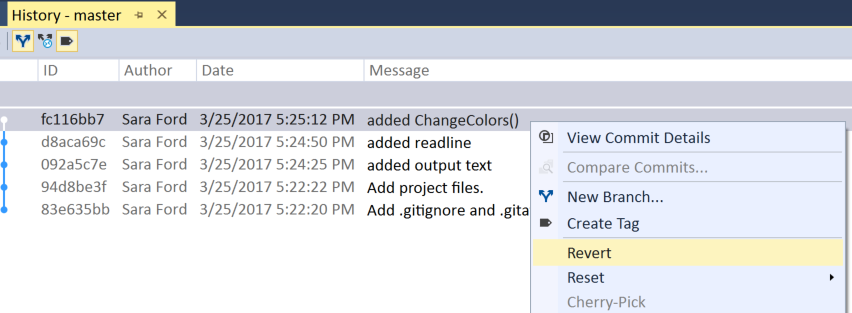
Going to the history shows where this change was introduced, i.e. “added ChangeColors()”. You can revert this commit by right-click and selecting “Revert.”

History - Revert on selected commit

Click Yes on the confirmation prompt.

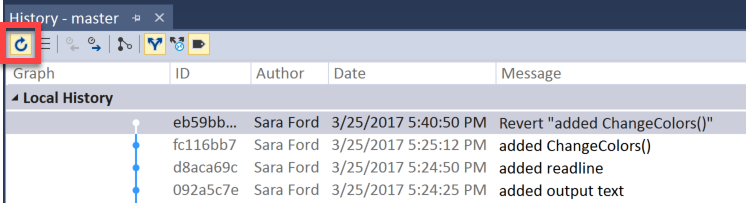
If you refresh History, you’ll see the new commit.

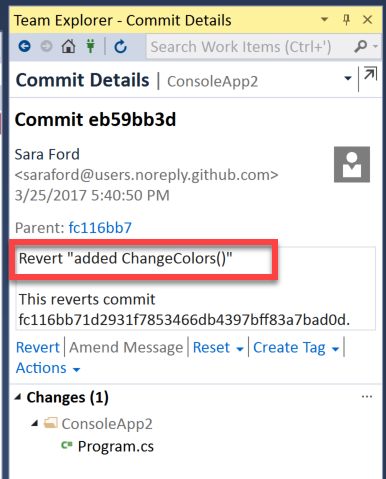
Revert "added ChangeColors()"

You can double-click to open that commit’s details. If you edit the commit message, the Amend Message option will become available.

reverted commits details

Double-clicking on the Program.cs file listed under Changes for the Commit Details pane shows what’s been removed or “reverted” from the codebase.

Changes for Program.cs showing the ChangeColors method removed

And to verify we are back to our familiar console application background, let’s run the project.

default black background for console app

How to use the VS status bar buttons as a shortcut to Team Explorer panes – 083

Something new in Visual Studio 2015 and still there in Visual Studio 2017 is the ability to click buttons(!!!) in the status bar O_O.

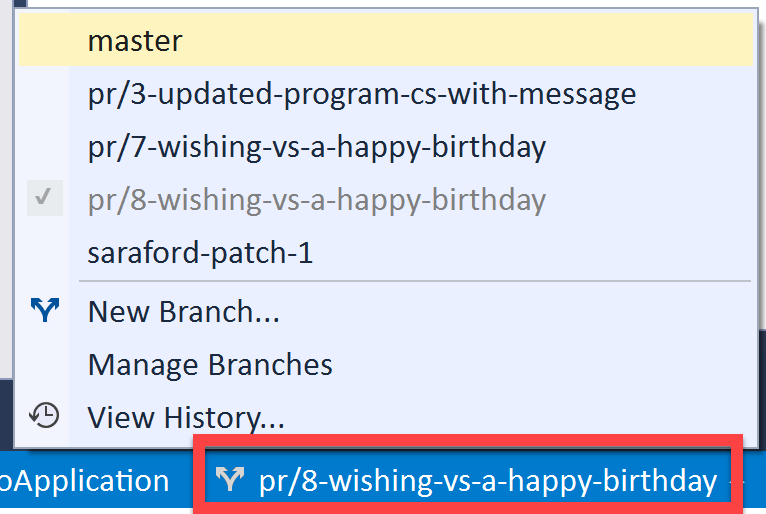
You can switch branches without having to touch the Team Explorer pane.

branches button shown in status bar w list of branches to checkout

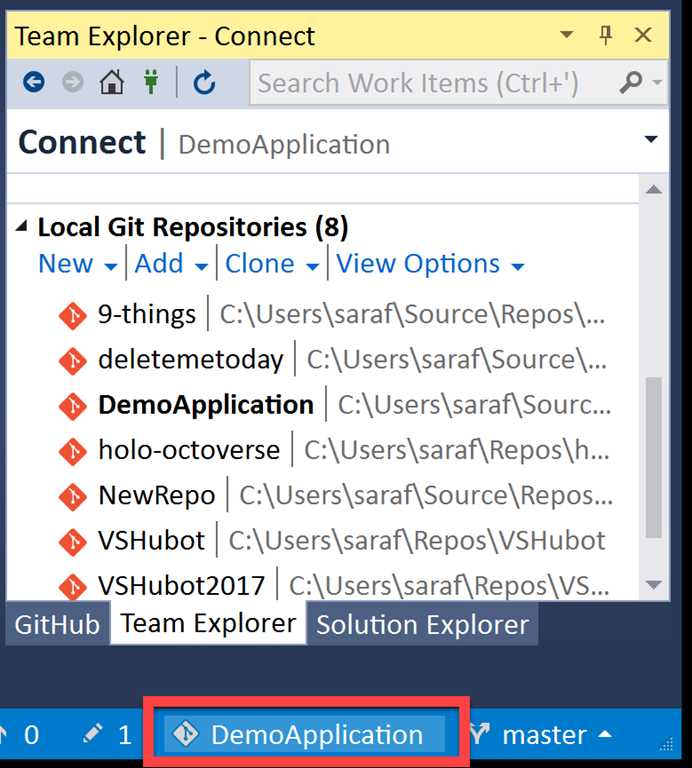
You can jump to the Connect pane, which will save you time when you’re debating “is it the Home icon or the green Plug icon?”

repo button in status bar showing Connect pane

Yeah, I guess I need to get around to deleting deletemetoday one of these days…

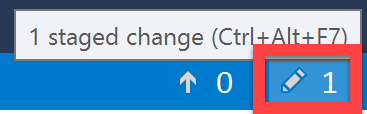
You can jump to the Changes pane, regardless whether you have uncommitted changes (or staged changes as shown in my screenshot – yeah SDET skills die hard).

This button won’t automatically commit your changes, but only takes you to the pane.

pen or pencil icon button for Changes pane

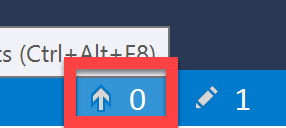
And last but not least, you can jump to the Sync pane. Again, it doesn’t perform any commands other than just navigating to the pane.

up arrow button for Sync pane

Looks like you can click the Line, Column, and Character status bar “buttons” and new UI appears for Visual Studio 2017!! (provided you have a file opened).

Must focus on Git and GitHub tips

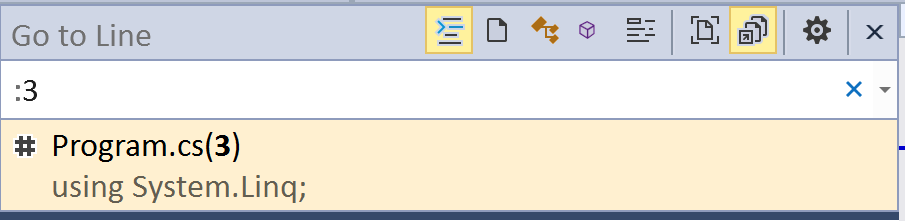
Okay, it looks like if you double-click on any of those status bar buttons, you’ll get a new Go To Line dialog, which seems to be part of a global search window…

new Go to Line window in VIsual Studio 2017

but it doesn’t seem to let you specify columns or character positions.

Yeah, old habits die hard, even when trying to focus.