Month: March 2017

How to make quick edits in the diff view in Visual Studio – 067

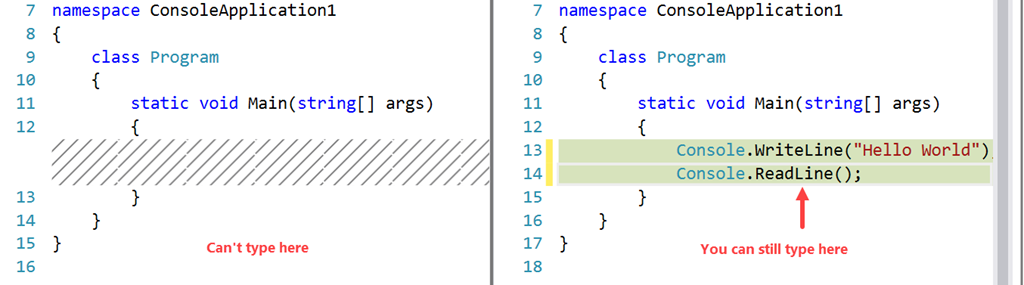
I always assumed that if you’re diff’ing the working directory against the last commit (i.e. Compare with Unmodified), both sides of the diff would be read-only. Turns out, only the last commit (left-hand side) is read-only.

For example, suppose you’ve made some quick edits in Program.cs (see yesterday’s tip), and you’ve opened the diff in the Editor by right-clicking and clicking Compare with Unmodified, you can still make edits on the right-hand side.

Added a new line of code on right-hand side

In this example, I’ve added a Console.ReadLine(), as anyone who has ever created a throwaway console app knows why. (I thought at one point in VS 20 year history if you switched from debug to release, the console app persisted until you closed it, but it looks like that’s no longer the case)

As soon as you hit save, you can confirm via the command line that Visual Studio is being honest that you can edit changes on this right-hand side.

git diff confirming changes to right-hand side

How to use the GitHub tool window to make changes to a Pull Request from a contributor in Visual Studio – 066

We recently launched support for what we call “Maintainer Workflows.” You’ve got an open source project and you’re receiving pull requests. Suppose you want the contributor to make some changes. You can leave comments in the Pull Request asking them to make whatever adjustments, e.g. adding a Console.Read(); in a Console Application project. But what if they don’t respond in a timely manner or never respond at all? Now within Visual Studio you can pull down those changes, review them, make modifications, commit and push back up to GitHub, all within the GitHub tool window!

(P.S. the Pull Request contributor needs to create the Pull Request by keeping the “allow edits from maintainers” checkbox checked by default. see more at bottom of post).

Continuing from yesterday’s tip, let’s say you’ve reviewed the diff for the PR but you want to make one addition.

1. You can click on the Checkout to <pr/pr-title> link button to checkout the branch.
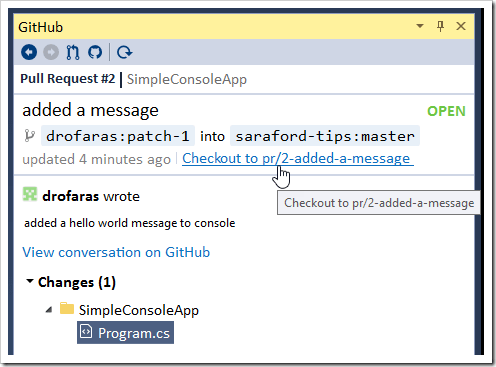
Checkout to pr/2-added-a-message being clicked in GitHub tool window

Clicking on the checkout… link indicates whether the checkout was successful. If not, it’ll tell you to go to Team Explorer – Changes to see what you have uncommited or unstashed.
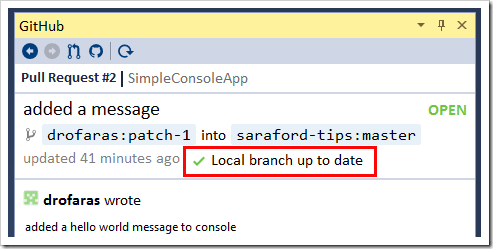
Local branch up to date message shown

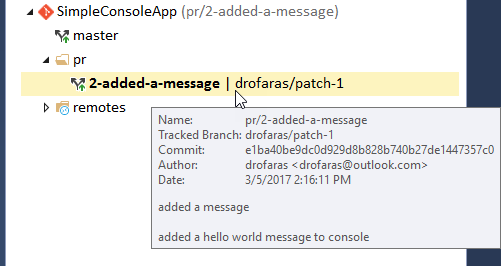
If you want to verify what state you are in, you can go to Team Explorer – Branches to confirm you’ve checked out a PR branch. Hovering over gives you additional information. You can also view in the VS status bar.
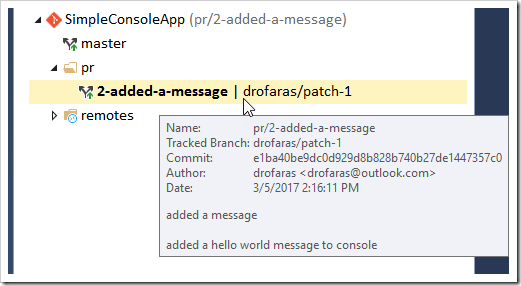
Team Explorer - Branches showing the pr branch checked out

2. Open the solution (if not already opened from Team Explorer – Home – Solutions) and then open the file you wish to modify.

In this example, I want to add a Console.Read() under the Console.WriteLine() that came from the Pull Request.

Console.Read() added to the PR by repo maintainer

Don’t forget to save and test your changes! // This is a note for myself 🙂

3. Go to Team Explorer – Changes and make your commit(s) to the branch

Team Explorer - Changes showing the commit for the Read()

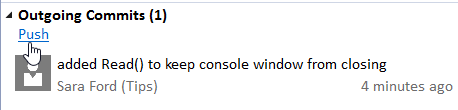
4. Push your changes back up to GitHub from the Team Explorer – Sync page

Team Explorer - Sync - Push changes

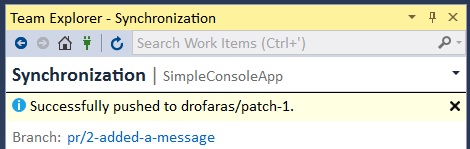
And you should see a success message.
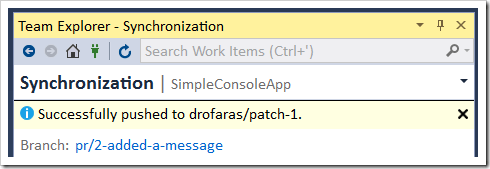
Successfully pushed to drofaras/patch-1

(We’ll cover more about Syncs in VS in a few weeks.)

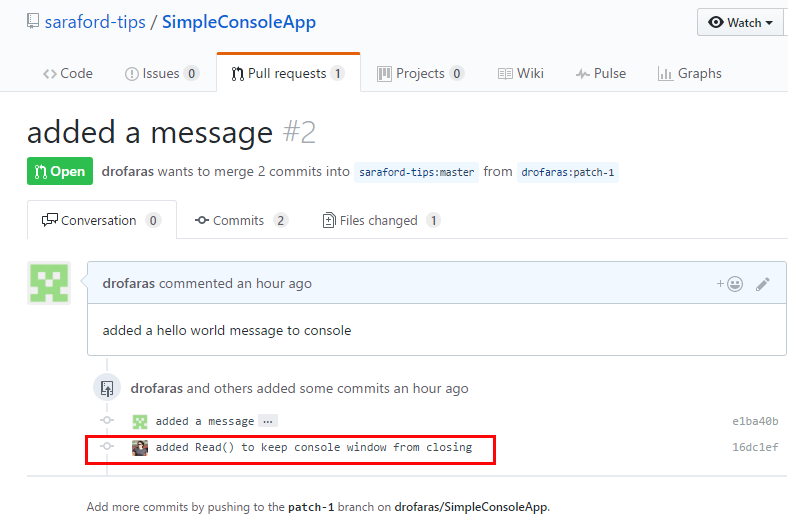
If you go to GitHub.com to review the Pull Request, you’ll see that there’s been a new commit.
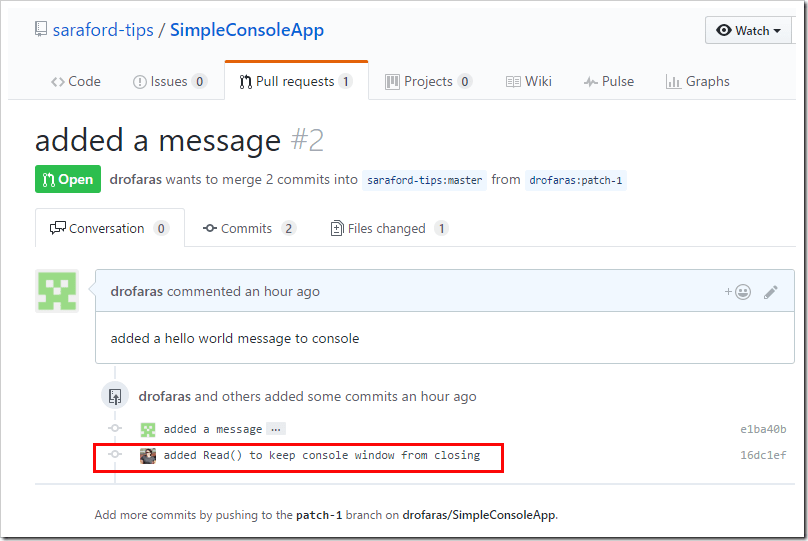
pull request page showing the new commit

Recap

Let’s take a minute to review what’s going on here. Remember a Pull Request is the start of a conversation. The actual code for the Pull Request sits on a branch that can be updated at anytime, hence why I say a pull request is the “start” of a conversation. In the past, this branch would be updatable by the person who created it. Now because of the new feature upstream repository contributors to collaborate on a forked branch, the user saraford-tips was able to make changes directly to the branch associated with the Pull Request from user drofaras.

When user drofaras created the pull request, she (or I) kept the checkbox checked to allow edits from maintainers.
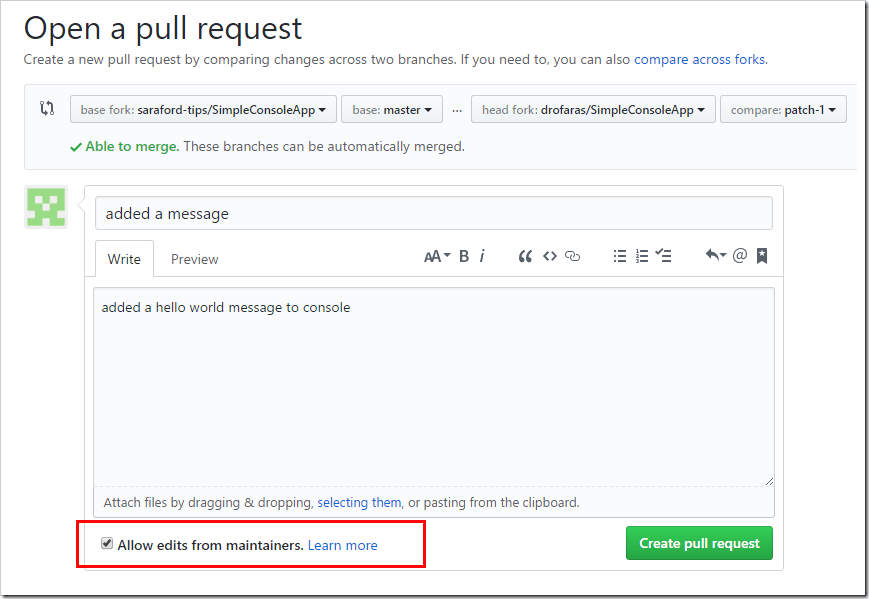
allow edits by maintainers

Got Feedback?

I strongly recommend using one of the existing channels for feedback. Of course, I’ll help anyone who leaves comments. It’s just that if you use one of the existing channels, your feedback and questions go to the entire team; whereas this blog is my nights and weekends project, so it’ll take me a while to respond, but I will respond. Just don’t ask me how small my queue of tips has become! O_O
How to review changes in a pull request without switching branches in Visual Studio – 065

I’m disrupting your regularly scheduled tip series to talk about the awesome work the Editor Tools team has been doing at GitHub. I’m too impatient to wait for the series to catch up!

We have a GitHub Extension for Visual Studio that’s available in Visual Studio Gallery / Marketplace which is also an open source project at https://github.com/github/visualstudio. You can go to Tools – Extensions and Updates and under Online search for GitHub to install.

Once installed, you can open the GitHub tool window from View – Other Windows – GitHub

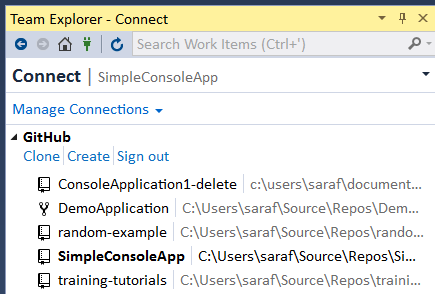
In the interest of time, I’m going to assume you are 1. connected to GitHub (either by signing in via Team Explorer or the GitHub tool window) and 2. in Team Explorer, you’re connected to a GitHub repo, as shown below

Team Explorer - Connect showing connected to SimpleConsoleApp repo

How to review changes in a pull request without switching branches

1. Go to Team Explorer –  Home – Pull Requests

Team Explorer - Home - Pull Requests button being clicked

Clicking Pull Requests will take you to the GitHub tool window, showing all of your open pull requests for your currently connected repo.

Note by default the GitHub tool window shows Open pull requests. You can filter to see closed and all pull requests.

GitHub tool window showing an open pull request 

2. Click on the title of the pull request (e.g. added a message) to view the details.

GitHub - Pull Request Details View

Ignore my funky font sizes. I’m making it to 40 without computer glasses. That one summer 10 years ago was an exception.

Lots of stuff going on here. We see

  • User drofaras wants to submit her (yes, my alias spelled backwards) branch patch-1 (the default name GitHub supplies to branches created via the website) into master.
  • A”checkout” link button, but the goal of this blog post is to review changes without switching branches. (stay tuned for tomorrow)
  • The details about the pull request and the option to view it on GitHub.
  • Lastly, there’s Changes (1) because only one file has been changed.

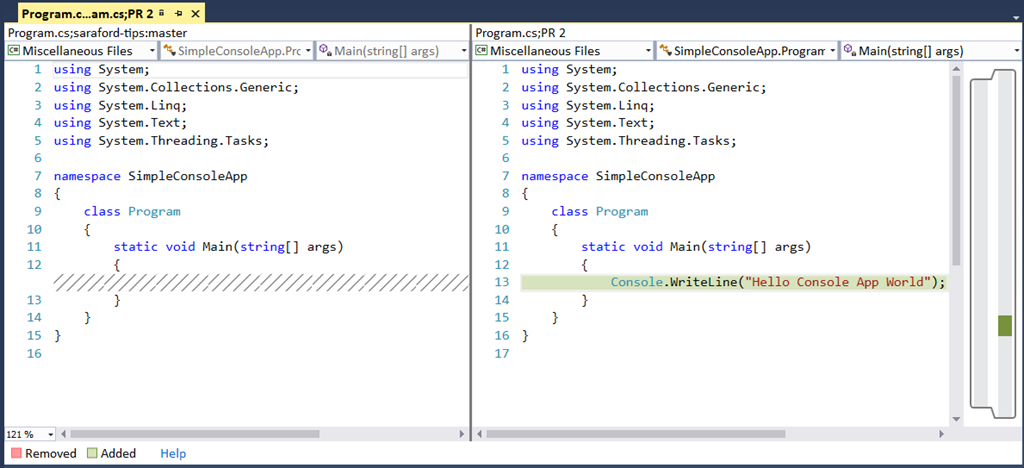
3. Double-Click on Program.cs to view the file diff

VS showing the diff between the two files

And that’s how you can do a diff between two files without switching branches within Visual Studio using the GitHub extension.

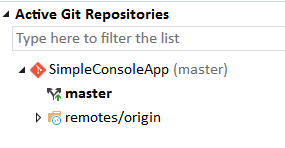
To show we’re still on the same branch as before (e.g. master), go to Team Explorer – Home – Branches to verify.

Team Explorer - Branches showing master as current branch

Got Feedback?

I strongly recommend using one of the existing channels for feedback. Of course, I’ll help anyone who leaves comments. It’s just that if you use one of the existing channels, your feedback and questions go to the entire team; whereas this blog is my nights and weekends project, so it’ll take me a while to respond, but I will respond. Just don’t ask me how small my queue of tips has become! O_O

How to view changes to your working directory in Visual Studio (and via command line) – 064

Yep this might seem trivial, but two things: 1. I discovered something new (see tomorrow’s tip) and 2. I’m playing with formatting of VS vs CLI

How to in Visual Studio

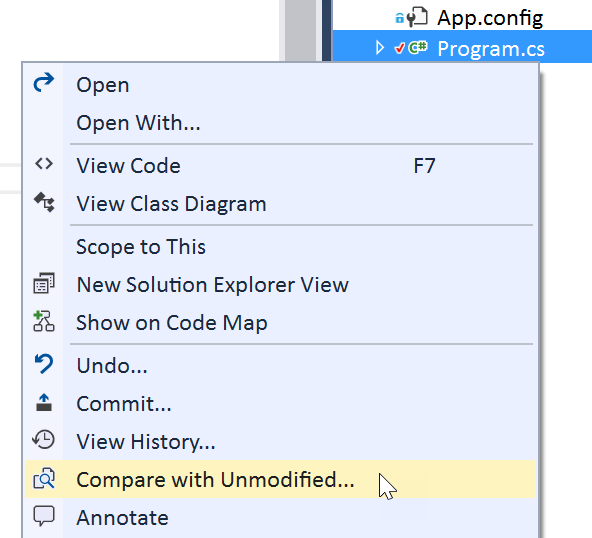
In Visual Studio, if you want to compare your current changes (i.e. changes in your working directory) to those in your last commit (where HEAD is at), you can right click on the file in Solution Explorer, in the Editor, in Team Explorer, aka practically anywhere, and select  Compare with Unmodified…

Compare with Unmodified

This command will open a diff of the file at HEAD and the file in the working directory,

Program.cs;HEAD vs. Program.cs

where you can see the changes in the diff side-by-side, where the Console.WriteLine was added.

Diff showing Console.WriteLine() message being added

How to via Command Line

Here’s how to do the same via the command line. Open the command prompt and navigate to your solution.

PSA: If you don’t have the Productivity Power Tools installed, go get them! Then you can right-click Program.cs and select “open in command prompt.”

To compare changes from your working directory (i.e. what you haven’t staged or committed yet) to your last commit (where that HEAD pointer thingy is at), run the following command

git diff

and now you’ll see the equivalent diff in the command line interface

command line showing "git diff"