Month: March 2017

How to amend changes to your code in your most recent commit – 074

Yesterday’s tip was about making changes to your commit message. Today’s tip is making changes to your code as well.

Hey my Git experts friends reading this! I’m not sure what the command line equivalent is, so can someone look at my section below on using the CLI and tell me why I have to use –allow-empty?

We’ll start with Team Explorer in Visual Studio and then rinse and repeat with what I think is the equivalent git command.

Amend using Visual Studio

It looks like Team Explorer will let you amend based on whatever changes are in the working directory, but just in case you only want to change one file, I’d suggest staging the file(s )you want to amend first. In a command line scenario, whatever files are in staging are the ones that will be amended. (See previous tips)

Actions button in Team Explorer

Click on the Actions button and select Amend Previous Commit.
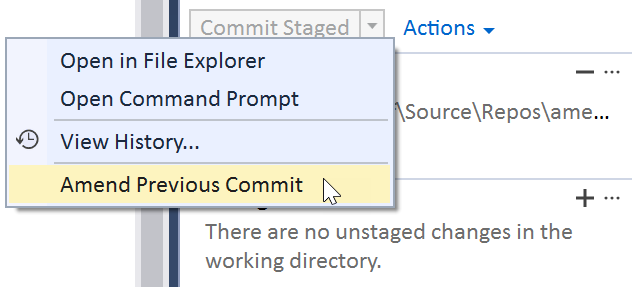
Amend Previous Commit

And you’ll get a new commit ID.

new commit ID shown in TE info bar

Amend using Command Line

Full disclosure: I don’t know when to use the –allow-empty option. I also don’t know what the ramifications of using it are. It seems I need to use this option even though 1. the staged changes are different than those in the commit history and 2. I’ve specified a commit message. TBH I’m not sure what is going on here.

But this is my best guess at the command line equivalent of what Team Explorer is doing.

  1. make changes to your file
  2. use git add to add those changes to staging
  3. git commit –amend -m “new message” –allow-empty or git commit –amend –allow-empty (but I’m not sure)

The below screenshot shows what happens when I don’t use the –allow-empty option.

git commit --amend -m "new message" wants the --allow-empty even though changes are staged

and here’s what happens when I use the –allow-empty, which turns out to be the behavior I want (or as far as I know!)

git commit -m "update readme" --amend --allow-empty shows success

So yeah, if you know what is going on wrt to the –allow-empty option, please let me know!!

How to amend your most recent commit message on your local repo from the command line – 073

Following yesterday’s tip where you learned how not to panic when presented with a vi editor, today’s tip will cover the scenario of what if you wanted to amend your most recent commit message.

Suppose you had a git commit message “updating readmeee” which you’ve caught immediately. The most straightforward way is git commit -m “new message” –amend

git commit -m "updating readme" --amend updating last commit message

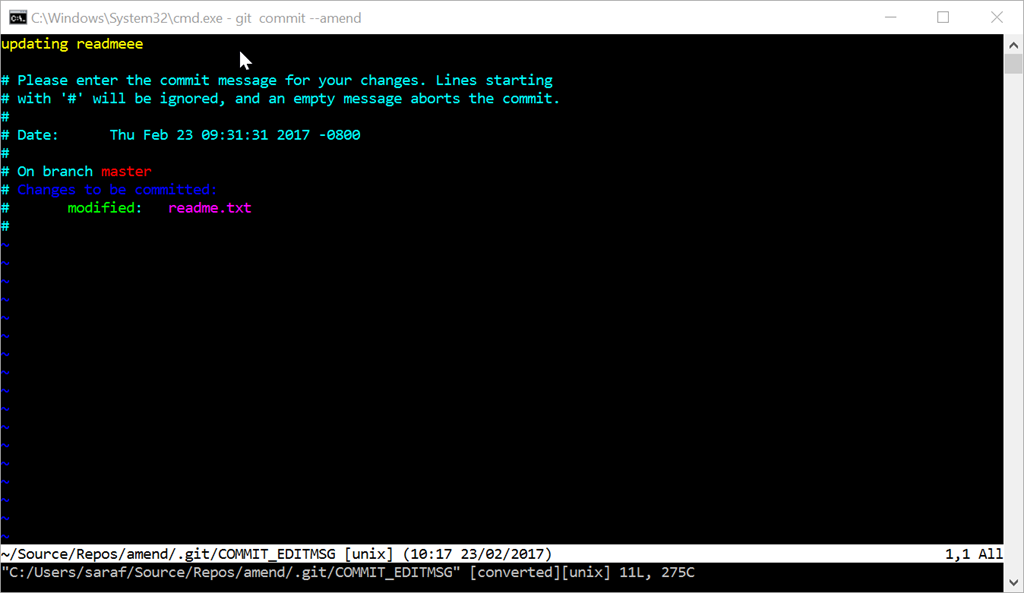
But let’s say you forgot the message flag and now you’re now face-to-face with the vi editor.

DO NOT START IMMEDIATELY TYPING! IT’S A TRAP!

star wars it's a trap meme

When vi first opens, your cursor will be in command mode, despite seeing the cursor in the editor. (pssst… it’s a trap)

image_thumb[12]

You’ll want to press The status bar at the bottom will change to show —Insert–

SNAGHTML717cfa_thumb[2]

Once you are finished with your edits, hit ESC to enter Command Mode, and then press :wq for write and quit.

and voila, you’ll see in your log that your last commit message has been modified, but the timestamp (and rest of commit history) is still the same.

image_thumb[21]

How not to quit your career when Git opens a vi editor – 072

There’s a joke, “How do you generate a random string? Put a Windows user in front of vi editor and tell them to exit.” Credit to Aaron Jorbin.

Suppose you’re doing research on the git commit –amend -m “some message” command and you forgot the -m “some message” part.

Everything spins around and suddenly I’m elsewhere…*

vi editor - one of the scariest images a Windows user will ever see

I’m in a sandy beach on a tropical isle.

Actually, you’re in the vi editor. Before you start typing anything, stop. Get up, stretch your legs. Odds are you’ve been at your desk for way too long anyways 🙂 Get some coffee and come back and search google what to do before you start typing.

If you are like “Say Yoho! SAY YOHO!!!*” to get out of here without making any changes, you’ll want to hit ESC and then type :q! Don’t think about it. just do it.

typing in the command :q!

You can verify in the git log that the amend had no impact.

*The reason I got into computer programming was because of Scott Adam’s Pirates Adventure text-based adventure game for the TI-99 4A Home Computer. As a 6 year old, it fascinated me how a computer could understand some English commands (get safety sneakers) but not others (open refrigerator – you are in a kitchen after all!) “Say Yoho!” was the command to jump to a different part of the island. Say it too many times in a row and you’d die (I think). Never beat the game as a kid, but later in college, I downloaded an emulator and finally got past those crocodiles!

How to undo changes to a file that has been staged in Visual Studio – 071

Almost always, every answer on SO for “how to undo changes to a file in Git…” starts with “well, it depends on what you mean by undo changes.” I’m starting to see why all these answers start by clarifying what you are trying to do.

Personally, there seems to be two cases where I want to “revert or undo” from staging:

  1. I’ve accidentally used git add . and added files that I didn’t mean to add to staging
  2. I’ve changed my mind on whatever code I was writing (e.g. the code didn’t do what I wanted, or more likely, never compiled) and want to pretend I never wrote it in the first place because I forgot to create a branch first

How to unstage changes in Team Explorer

Right-click on the file you want to remove from staging and select the Unstage command.

Unstage command in TE

And Team Explorer will put it back to the Changes list. You can confirm this in the command line as the file will be listed under Changes not staged for commit.

If you’re going for the destructive “let’s never speak of this code again” option, follow yesterday’s tip by right-clicking on the file and selecting the Undo Changes… command.

How to unstage changes in Command Line

Rinse and repeating for the command line, let’s stage our commit using git add Program.cs and confirm it using git status. Although git never says “staged”, you’ll just have to translate “Changes to be committed” to “These changes are staged to be committed”

git status showing a staged Program.cs

Now to unstage the changes, you can read the instructions in the git status (see above).

Running git reset HEAD Program.cs puts it back as an modified file that hasn’t been staged yet.

git reset HEAD program.cs provides feedback

Wow! Git actually provides feedback with this command. You see in the message above unstaged changes after reset. I’ll never understand why Git decides to give feedback on some commands and not others.

And doing one more git status will show you the commands to fully remove the changes, although destructive.

git status showing how to revert or undo changes to file in working directory

And lastly doing a git checkout — Program.cs will undo all changes to that file to the last commit.

command prompt showing nothing to commit